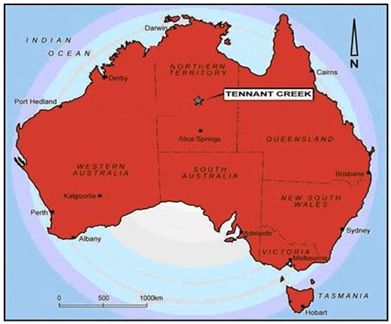
Project Locations
The projects currently in Truscott's portfolio are located close to Tennant Creek, Northern Territory and at the Halls Creek Mobile Belt (Legune), Northern Territory. They were acquired based on regional structural analysis, evaluation of historical major mines and mineral occurrences. The Directors consider the Tennant Creek projects to be highly prospective for iron oxide copper gold (IOCG) and the Legune division highly prospective for uranium.
Tennant Creek Overview
The Tennant Creek projects (Figure 1) are all close to the regional gold mining centre of Tennant Creek, in the Northern Territory. Over 5.5 million ounces of gold has been produced from this area, at a very high average recovered grade of 19g/t Au, together with significant copper, bismuth and silver.
Research and Development Initiatives
Historically, exploration in the Tennant Creek Field has relied heavily on traditional methods of exploration related to geophysical and geochemical techniques. These tools whilst still relevant appear in recent history to be insufficient to generate new discoveries of commercial significance.
Truscott therefore sought to investigate the introduction of other techniques that would have the potential to increase the level of business success. The company has now advanced initial work on a regional basis that focuses on the relationship between mineral occurrence and distribution within a shear zone array.
The interim objective of the exercise is to identify zones of dilation created as consequence of shearing as places to trap potential mineralising fluids.
The overall objective is to ensure the company is advancing exploration activities on a basis of targeting ore bodies of sufficient magnitude to have the potential to lead to the development of major operations.
For logistical reasons the company is focusing its exploration activities in an area within 25km of the Tennant Creek Township. Within that area the underground operations at Peko and Juno stand out. Past and present reported inferred and indicated resource tonnages for each deposit now total more than 3 million tonnes.
The application of the first phase of the company's modelling has enabled the identification of eight primary nodes that exhibit similar geological settings to the major deposits identified. These nodes are illustrated on the Tennant Creek map sheet of Figure 1.

Figure 1 Interpreted Principal Exploration Nodes Central Tennant Creek Mineral Field
Of the eight interpreted principal nodes, Truscott holds 100% tenure over Westminster, Lyall, Hera, Olympus, and Arcadia. The node interpreted over Peko has had substantial tonnages of ore mined while the interpreted node over Juno has only been partially exploited.
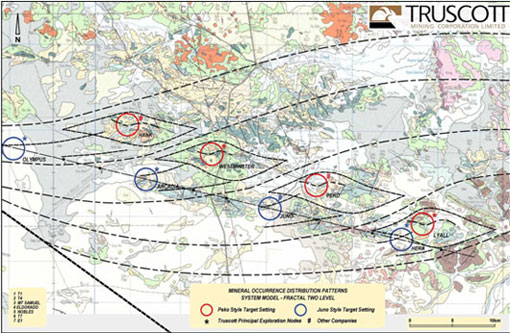
A number of secondary nodes have been interpreted which are considered to be of lower prospectivity are indicated as numbered points on a 2850 line that has been referred to as the "Southern Shear". These intersection points have the potential to host high grade but lower tonnage mineralisation than the primary nodes located more centrally within the larger scale trend envelopes.
Truscott is focusing its exploration efforts on the primary node locations which are interpreted to be similar to the Peko. Several characteristic features have been identified which include:
- Deposits appear to have several discrete ore bodies
- Ore bodies appear to be related to envelopes or trends
- Ore bodies are developed proximal to the flexure of the mineralised trends.